The extraction and processing of aluminium metal can be broken down into three key stages: the mining of bauxite ore, refining that ore to recover alumina, and then the smelting of alumina to produce aluminium sheets or ingots. This type of metal is prized for its strong yet lightweight properties, as well as its resistance to rusting.
Although aluminium is the third most abundant element to be found in the Earth’s crust (after oxygen and silicone), it has only been widely utilised over the last 100 years. This is because it does not exist in nature in a pure state, and must be extracted from compounds through an intensive refining process.
Australia’s aluminium industry is the world’s largest producer of bauxite, despite having only been in commercial operation since 1955. It is a major contributor to employment and the national economy, generating around 21 million tonnes of alumina material each year.
Michael Greelish, national accounts manager for mining at Motion Australia, worked recently with a Victorian aluminium smelting business to implement NTN’s angular contact ball bearings on various machinery parts to great success. The company itself produces approximately 300,000 tonnes of aluminium every year, adhering to robust environmental management plans and sustainability targets.
“We are proud to support such a forward‑thinking player in the Australian mining space, supplying them with the best quality bearing components to ensure that they meet efficiency targets,” Greelish said.
“CBC carried out assessment on their application where part failure was becoming a costly issue, and recommended the angular contact ball bearings from NTN as a premium, long-term solution that could promise reliability.”
These non-separable bearings are incredibly useful, due to their ability to support simultaneous radial and single‑direction axial pressure. Because of this, they are usually used in pairs or sets to transmit load between raceways along a radial plane. Popular with OEM customers, these NTN units have been generating widespread positive feedback following extended operating life on different sites.
“Put simply, the NTN product is one of the best on the market, and can be fitted without fuss if the situation calls for efficiency,” Greelish said.
“When you have got a failure on a generic bearing, or need to carry out maintenance change-overs, the last thing you want is extended downtime. These angular contact ball bearings also feature a ‘flush ground’ finishing method, which allows for universal pairing and back-to-back arrangement if required.”
Resistant to premature fatigue, this product has proven longevity in harsh mining conditions and under extreme pressure peaks. The steel bearing cages are set to maintain rolling elements at a uniform pitch, so that the load does not fall onto the cage directly. This prevents the rolling elements from falling out when the bearing is handled by fitters or technicians.
“Their design is seriously smart, and addresses the concerns of every-day industrial operations,” Greelish said.
“Pretty much any application requiring angular bearings could benefit from this product, because they are available in such a broad catalogue of sizes and arrangements.”
Since 1971, CBC and NTN have operated under a joint venture partnership, delivering expert engineering products to the Australian mining market and beyond. As one of the top five bearing manufacturers in the world, NTN sets an international standard for end-to-end logistical service and supply.
Features and benefits of the NTN Angular Contact Ball Bearings • Peak performance in high or low temperature settings • Lower starting friction coefficient • Low lubrication consumption • Internationally standardised and readily available through CBC • Improved pre-loading due to bearing rigidity • Accessible and efficient product numbering system • Can simultaneously support radial and axial loads
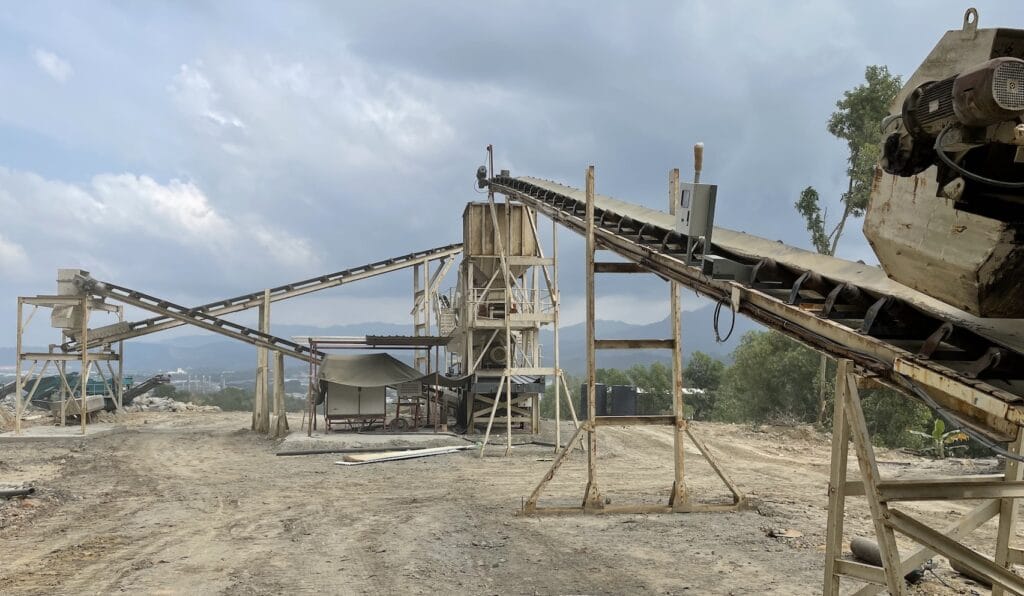
The Terex equipment was successfully relocated over 150km through Malaysia. Image: Terex MPS.
Terex MPS has managed to relocate a range of crushers in a remote forest reserve in Sabah, Malaysia, highlighting the durability of the machinery.
The equipment was originally installed 150km away from Sabah and hadn’t been used for more than two years over the course of the pandemic. However, a restart was flagged and Terex was called in to relocate the machines.
The plant was a wheeled jaw WJ1175, including a Terex JW42 primary jaw crusher, as well as a Terex wheeled cone model WC1000 containing a Terex TC1000 model cone crusher.
The combined weight of the equipment was more than 70 tonnes.
Terex MPS regional sales manager Benjamin Tong said these specific models were well suited to the customer’s needs.
“The versatility of our wheeled plant was the main reason that the customer chose Terex originally,” Tong said.
“The IV Deck screen also makes it easy for the customer to cope with the market demand for four different aggregate sizes.”
The equipment now sits 2500m above sea level overlooking Mount Trusmadi.
“The service support provided by Terex MPS team was also highly appreciated by the customer, which resulted in a quick turnaround of the plant and in turn production,” Terex stated.
“Now sitting at the top of a new site some 150km from the old site… the Terex MPS systems are working together as one, once again, after years of sitting idly by.
“The one-of-a-kind optimisation of the machines, along with their premium quality components has saved the customer time, labour costs and overall relocation costs during a time when the market is at its most challenging.”
When operating track type tractors, around 50 per cent of the total cost associated with owning and operating for the life the tractor, is in its undercarriage.
With a fleet made up of over 350 machines, the Mackellar Group prides itself on maximising the uptime of its equipment by investing in genuine Cat parts and regular Custom Track Service (CTS) Inspections.
As part of the dealer support provided by Hastings Deering, CTS Inspections are scheduled with the Mackellar Group to gather quick and accurate analysis of undercarriage wear rates.
Jarrod Sharpe, third year apprentice for Mackellar Group, said that the CTS Inspections helped the maintenance team to understand how the undercarriage is wearing and allowed them to rectify issues before they come up.
“They use ultrasonic technology, they’ve got more analogue, idle and depth gauges and ultrasound equipment where they can give you a precise depth on your track links, on your rail height segment wear,” Sharpe said.
The CTS inspections utilises Cat Wear Management System (CWMS) which incorporates Ultrasonic Wear Indicator technology to assess and advise on the condition of a machine’s undercarriage directly measuring the most critical dimensions on Cat undercarriage.
Using this technology, the Hastings Deering Product Support representatives can analyse the bushing wall thickness, link rail wear, track shoe wear limits, idler centre flange wear and track roller wear.
These advanced diagnostics are then compiled into a detailed report on wear projections for the Mackellar Group which can access and use the data from CWMS, to plan its undercarriage change outs to maximise machine uptime.
Peter Pelling, group maintenance manager for Mackellar Group said that this analysis has helped the Mackellar Group to evaluate service options, plan maintenance and schedule planned downtime to ensure its fleet is at maximum productivity.
“Custom Track inspections are very important, so then we know if we can go in and change a set of tracks out and achieve maximum life out of bush wear. It’s the downtime that kills us,” Pelling said.
“We’ve always favoured the Caterpillar genuine parts in our undercarriage because reliability is just there.”
“We pride ourselves on keeping our machines moving, we don’t want to be down, and that’s why we use Hastings Deering support and genuine Caterpillar Parts.”
To keep up to date with Australian Mining, subscribe to our free email newsletters delivered straight to your inbox. Click here.
The site of the Saint Elmo vanadium mine in Central Queensland. Image: Multicom Resources
The Queensland Government has recognised the importance of vanadium as a new economy mineral with plans for a processing plant in Townsville.
The mineral is used in large-scale grid batteries called redox flow batteries. These batteries store the charge in liquid form, enabling larger capacities.
Queensland Treasurer and Minister for Trade and Investment Cameron Dick said vanadium would play a significant part in the state’s transition to clean energy.
“We want regional Queensland to be a global leader when it comes to everything that’s part of the renewable energy revolution,” he said.
“Australia has the world’s third largest deposits of vanadium resources, but right now we don’t produce a single kilogram of processed vanadium.
“The mining companies looking to process vanadium at an industrial scale don’t have the capital necessary to make that jump. That’s where our government can step in.”
The government will put at least $10 million towards the common-user facility, sourced from the $520 million Invested in Queensland program.
The Treasurer said it was still in the process of tendering for construction contracts and selecting the location.
“Once producers can see for themselves how processing occurs, they will have the confidence to invest in more manufacturing infrastructure and more jobs,” he said.
“Mining companies will be able to transport ore from their mine site to Townsville, enabling them to begin producing mineral samples at scale.”
Earlier in 2021, the mineral made headlines for Queensland’s mining industry when Multicom Resources announced the go-ahead for the $250 million Saint Elmo vanadium mine, 250 kilometres east of Mount Isa.
This mine and the new Townsville processing facility will ramp up concurrently, as both begin construction in 2022 with first production expected in 2023.
Queensland Minister for Resources Scott Stewart said these developments were only the start of Queensland’s vanadium industry.
“Saint Elmo is just the beginning, with other companies progressing other potential vanadium mines in what could become a world-class vanadium hub in the northwest, so having this processing facility in Townsville will ensure locals reap the benefits,” Stewart said.
To keep up to date with Australian Mining, subscribe to our free email newsletters delivered straight to your inbox. Click here.
BHP has officially opened its $4.6 billion South Flank iron ore mine in the Pilbara region of Western Australia, celebrating the completion of the project’s five-year journey on time and budget.
In 2016, the company began planning for a new operation to potentially replace its ageing Yandi iron ore mine, with environmental documents opened to the public in June of that year.
South Flank began gathering pace in 2017 when Decmil secured a $13 million contract with BHP for initial works at the proposed development.
The project scope included civil and enabling works at the Mulla Mulla village, which required expansion to support operations at Mining Area C and the South Flank project.
Contract mining and earthworks provider MACA (https://www.maca.net.au/our-business/crushing/crushing-and-screening/) secured a three-year contract to become a crushing and screening provider for BHP in May the following year.
BHP turned the first sod at the site a year later in July after the project received approval from the Western Australia Government.
In December, 2019, Mammoet started transporting the first heavy components for BHP’s South Flank iron ore project in the Pilbara region, Western Australia.
BHP used Mammoet trailers to move approximately 1900 items, including prefabricated and modular mine processing plant units across 340 kilometres from Port Hedland to the new site.
BHP contractor Fluor Corporation commenced the construction of the ore handling plant in the South Flank project at the start of January 2020.
Six months later the company held off a portion of mine development in June due to its impact on cultural heritage sites belonging to the Banjima people.
By August last year the company had developed more than three quarters of the South Flank project.
The company advanced its development projects and delivered strong results during the 2020 financial year despite the impact of COVID-19.
First ore was delivered at the site in May this year ahead of this week’s official opening with the development creating 9000 direct and indirect jobs during construction, and will sustain more than 600 permanent ongoing jobs.
The opening celebrations were attended by Western Australian Premier Mark McGowan, Banjima Traditional Owners and joint venture partners, ITOCHU and Mitsui.
The 80 million tonne per annum (Mtpa) site is the largest iron ore mine Australia has seen in over 50 years and combines with BHP’s Mining Area C to be the largest iron ore hub in the world – producing a combined 145Mtpa.
BHP Western Australia iron ore (WAIO) asset president Brandon Craig said South Flank is BHP’s most technically advanced mine.
“It will sustain more than 600 ongoing jobs, plus opportunities for hundreds of local businesses and billions of dollars in royalties to Western Australia,” Craig said
“South Flank’s product has high lump content and increases the quality of BHP’s blended products for steelmaking customers, improving blast furnace efficiency and supporting decarbonisation efforts.
“South Flank’s premium iron ore will be shipped to global steel producers to build electricity, transport and urban infrastructure around the world over the next 25 years.”
BHP has produced the first nickel sulphate crystals from its Kwinana nickel sulphate plant south of Perth in Western Australia.
Nickel sulphate is a key material in the lithium-ion batteries that power electric vehicles (EVs), with more than 85 per cent of BHP’s current production sold to the future-battery supply chain.
The production follows an announcement in July that BHP will supply Tesla with nickel from its Nickel West assets in a collaboration which will aim to make the battery supply chain more sustainable.
According to BHP, the nickel sulphate plant is an Australian-first and will produce 100,000 tonnes of nickel sulphate per year when fully operational.
Nickel from BHP’s mines is processed at the Kalgoorlie nickel smelter, before it is transported to the Kwinana nickel refinery and refined into nickel metal in the form of powder or briquette.
The powder is then processed through the new sulphate plant to make nickel sulphate and will be exported to global battery markets from Fremantle port.
BHP Nickel West asset president Jessica Farrell said the plant is expected to produce enough premium nickel sulphate to make 700,000 EV batteries each year.
“The plant will create 80 new direct jobs and support 400 new indirect jobs, in addition to the 200 construction jobs that were created during the construction phase,” Farrell said,
“High quality and sustainable nickel is essential for our customers, and we expect demand for nickel in batteries will increase by 500 per cent in the next decade.
“Our investment to upgrade the refinery to produce high purity nickel sulphate, along with nickel powder and briquettes, will enhance Nickel West’s position as a supplier of choice for the growing global electric battery market.”
Over half of the plant was fabricated in Western Australia using local skills and suppliers including the steel work, fibreglass leach vessels and stainless steel tanks.
The plant consists of leaching tanks, purification technology, a crystalliser and dryer, and an automated packaging system.
BHP’s Nickel West employs over 2500 people and its operations include a fully integrated mine-to-metal business.
This includes open cut and underground mining operations in Western Australia; concentrators at Mt Keith, Leinster and Kambalda; a smelter at Kalgoorlie that produces nickel-in-matte; and the Kwinana refinery.



 【更多OZL公告和股价走势请点击OZL个股页面 】




 【更多EVN公告和股价走势请点击